
The moment your valet takes the key, the car is your problem

The short answer
Valet parking liability in India begins the moment a guest hands car keys to your valet. From that point, your hotel is legally responsible for that car. The Supreme Court settled this in Taj Mahal Hotel v United India Insurance in November 2019. An "at owner's risk" line on the valet ticket does not protect you if your side was careless, and the burden is on you to prove you were not. The only real defence is a record.
It is 11:40 on a Saturday night
The wedding reception in your banquet hall is winding down. Forty cars are being called back at once. Your valet runs the length of the basement, finds a white SUV, and brings it up to the porch.
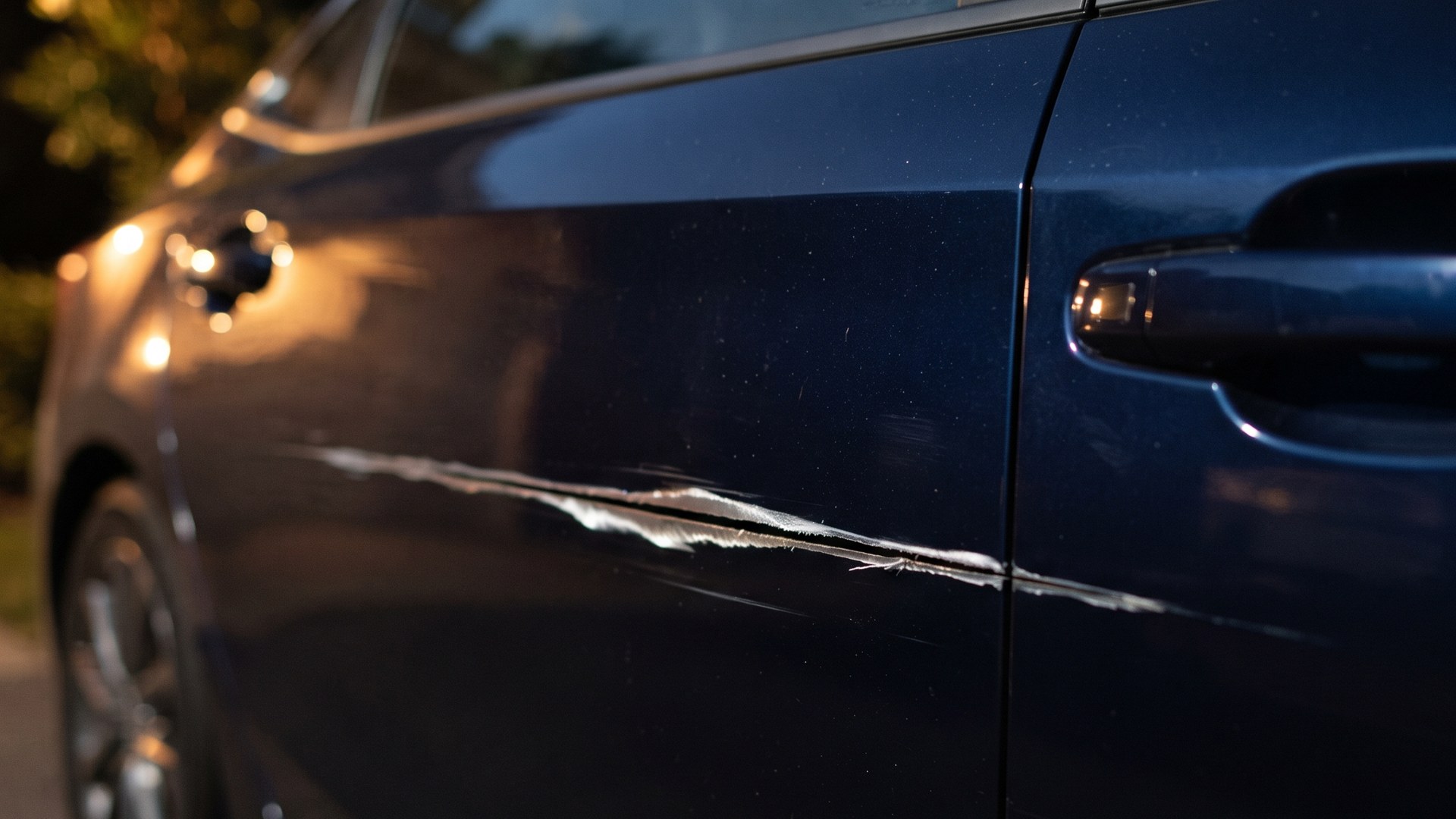
The owner walks around his car. He stops at the rear passenger door. There is a long scratch, fresh and shining under the porch lights.
"This was not here when I gave you the keys."
Your valet says it was already there. Maybe he is right. Maybe he parked it next to a pillar in a hurry. Nobody knows, because nobody looked. There is a paper ticket with a number on it, a key hook, and a tired 22 year old who has parked 60 cars tonight.
Now it is your problem. Not the valet's. Not the valet agency's. Yours.
If you run a hotel, a resort, a restaurant, a hospital or a banquet venue, you have either lived this night or you will. What most owners do not know is how clearly the law has already decided who pays for it.
The case that changed valet parking in India
On 14 November 2019, the Supreme Court of India decided Taj Mahal Hotel v United India Insurance Company, Civil Appeal No. 8611 of 2019.
The facts were simple. A guest arrived at a five star hotel and handed his car and keys to the hotel valet. The car was stolen from the hotel's parking. The hotel pointed to its parking tag, which said the hotel would not be liable for any loss or damage. The guest's insurer paid him and then went after the hotel.
The hotel lost. Here is what the Court said, in plain words.
When your valet takes the keys, the law treats it as a bailment under Sections 148 and 149 of the Indian Contract Act, 1872. Your guest has handed you possession of their property, and you owe it back to them.
It does not matter that the valet was free. The Court held that valet service benefits the hotel even when it is offered as a courtesy, so the guest has effectively paid for it through the meal, the room or the event.
Your "owner's risk" ticket will not save you from your own carelessness. The Court held that a hotel cannot contract out of liability for its own negligence, or the negligence of its staff, for a car entrusted to it.
The burden of proof sits with you. The guest does not have to prove what your valet did wrong. You have to show that you took the care the law expects. Upscale hotels are held to a higher standard of care than others.
Read that last part again. It is not the guest who has to prove the scratch happened on your watch. It is you who has to prove it did not.
Theft made the headlines. Scratches will cost you more.
The 2019 case was about a stolen car. Most valet disputes in real life are smaller and far more frequent. A dent. A scraped alloy. A cracked side mirror. A phone charger missing from the dashboard.
The judgment was about theft, and it is worth being precise about that. But the duty it describes is broader: once you take possession, you are expected to take reasonable care of the car and return it the way you received it. In our reading, the same logic follows you into every damage argument at the porch. Your legal counsel should confirm how it applies to your property.
What changes in every one of these arguments is one question. Can you show what the car looked like when your valet took it?
If the answer is no, you are left with three bad options. Pay for the repair and absorb it. Argue with an angry guest in front of other guests. Or let it become a complaint before a consumer commission and a one star review with your hotel's name in the first line.
Five places your valet desk is exposed tonight
Walk down to your porch tonight and look for these.
The paper ticket. It can be lost, swapped, photographed or handed to the wrong person. A ticket number proves that a car exists. It proves nothing about its condition.
The key board. Keys on hooks by the valet stand are open to anyone who walks past during a rush. One wrong key handed to one wrong guest, and you are back in the Taj Mahal Hotel case.
No condition record. If nobody photographs the car at drop off, every scratch found at pickup is your word against the guest's. The law has already told you whose word needs evidence.
No trail of who touched the car. When a dispute comes up the next morning, can you say which valet parked it, where, and at what time? Or does the answer depend on who was on shift and what they remember?
The hand back. When a car is brought to the porch, how does your valet confirm the person taking it is the person who gave it? A number shouted across the driveway is not verification.
If you found two or more of these, you are running a liability desk, not a valet desk.
"We have never had a problem"
Most owners say this. Usually it means the problems have been small enough to settle quietly at the porch, with a discount or a free dinner or a repair bill nobody tracked.
That is exactly what the ruling makes risky. A guest who knows the law, or whose insurer knows it, does not need to settle at the porch. And a guest who drove a luxury car to your five star property is precisely the guest most likely to have one.
How hotels can avoid valet parking disputes
You do not need a lawyer at the valet stand. You need a record that answers the questions a lawyer, an insurer or a consumer commission will ask. Whatever system you use, it should give you these five things for every car.
- Who took the keys, and at what time, recorded automatically rather than written on paper.
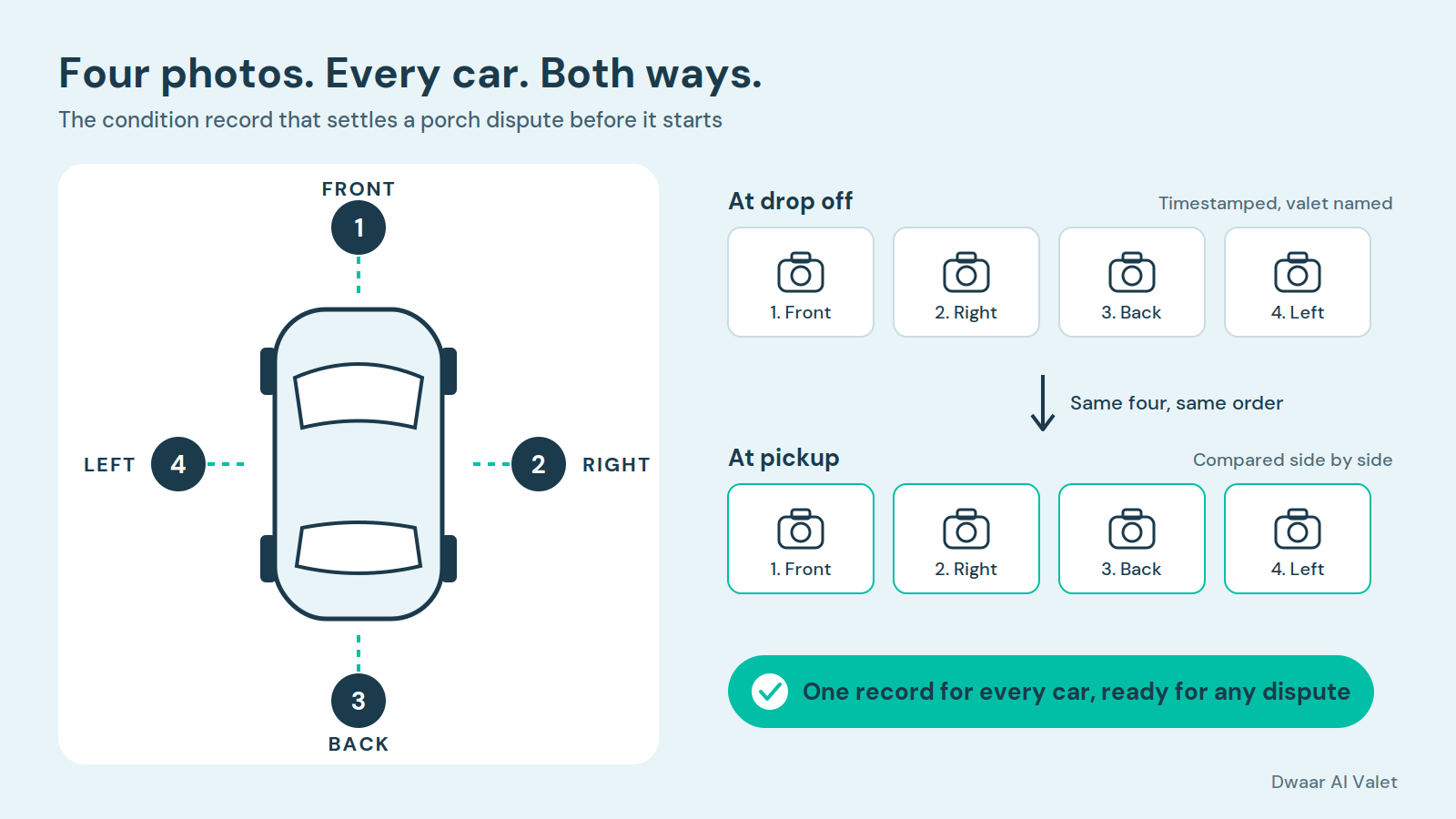
- Photos of all four sides of the car at drop off, taken in a fixed sequence so no side is skipped, with a timestamp that cannot be edited.
- The same four photos again at pickup, so drop off and pickup can be compared side by side.
- A verified hand back, where the car is released only to the person holding a one time code, not to whoever reads out a ticket number.
- A history you can pull up weeks later, when the complaint arrives after the guest has checked out.
With this, the scratch conversation changes. You open the drop off photos on a phone. Either the scratch is there, and the conversation ends politely. Or it is not, and you know you have a staff problem to fix. Both outcomes are better than guessing.
Why we built Dwaar AI Valet
I run Dwaar AI, and for years our work has been about one thing: making sure the right vehicle goes through the right gate, with a record of who let it through. When we looked at valet desks in hotels, we saw the same gap. A car worth lakhs changes hands on a paper slip.
Recently I sat down with the team at one of Bengaluru's leading five star hotels. Their biggest worry was not theft. It was scratches. Every dispute at the porch was being settled the same way, with a complimentary dinner or a discount on the next stay, because there was no record to settle it any other way. Each of those gestures was revenue quietly walking out of the hotel, and they wanted that gap closed.
Mukesh Jena, Founder, Dwaar AI
So we built Dwaar AI Valet, a digital valet parking system, around the five points above. Your valet photographs the car from the front, right, back and left at drop off, and the app will not move ahead until all four are taken. The guest gets a one time code and a live link to track the car on their phone. The same four photos are taken again at pickup. The car is released only against the code. Every handover is stored with the valet's name and time, for 70 days on the Basic plan and 100 days on Enterprise.
Setup takes 10 to 14 days, mapped to your parking layout and shift structure. You can see exactly how it works on the Dwaar AI Valet page, or book a walkthrough and I will show you a live handover myself.
Before your next Saturday night
The Supreme Court made its position clear seven years ago. The keys in your valet's hand are your responsibility. The only question left is whether you will have proof on the night someone asks for it.
This article explains a court judgment in general terms and is not legal advice. Please speak with your own legal counsel about your property's specific obligations.
Source: summary of Taj Mahal Hotel v United India Insurance, Supreme Court of India, 2019
Frequently asked questions
Is a hotel responsible if a valet damages or loses my car in India?
Yes, in most cases. In Taj Mahal Hotel v United India Insurance (2019), the Supreme Court held that handing keys to a hotel valet creates a bailment under the Indian Contract Act, so the hotel must take reasonable care of the car and return it safely.
Does an "at owner's risk" valet ticket protect the hotel?
Not against its own negligence. The Supreme Court held that a hotel cannot contract out of liability for negligence by itself or its staff. A disclaimer may still help for events genuinely outside the hotel's control, but only after the hotel shows it took proper care.
Is the hotel liable even if valet parking is free?
Yes. The Court held that complimentary valet service still benefits the hotel, so the guest is treated as having paid for it through the room, food or other services they used.
Who has to prove what happened to the car?
The hotel. Once the car is handed to the valet, the burden shifts to the hotel to show it took reasonable care. The guest does not have to prove exactly what went wrong.
How can a hotel protect itself from valet damage disputes?
By keeping a timestamped record of every handover. That means photos of all four sides of the car at drop off and pickup, the name of the valet who handled it, and a verified hand back to the right guest, stored long enough to answer a complaint that arrives after checkout.
What is a digital valet parking system?
A digital valet parking system replaces paper tickets with a phone based handover. The guest gets a one time code and a live status link, the valet records the car's condition with photos, and the property keeps a searchable history of every car handled.
Mukesh Jena, Founder, Dwaar AI
See a live handover
Dwaar AI Valet replaces the paper ticket with OTP handover and a four-photo condition record.
Book a demoDwaar AI also runs AI-powered gate management for gated communities.